

13 FEB 2026
ACCIONA and its partners present the results of the european innovation project LIFE INDESAL
- The project team has developed a novel and energy-efficient desalination system.
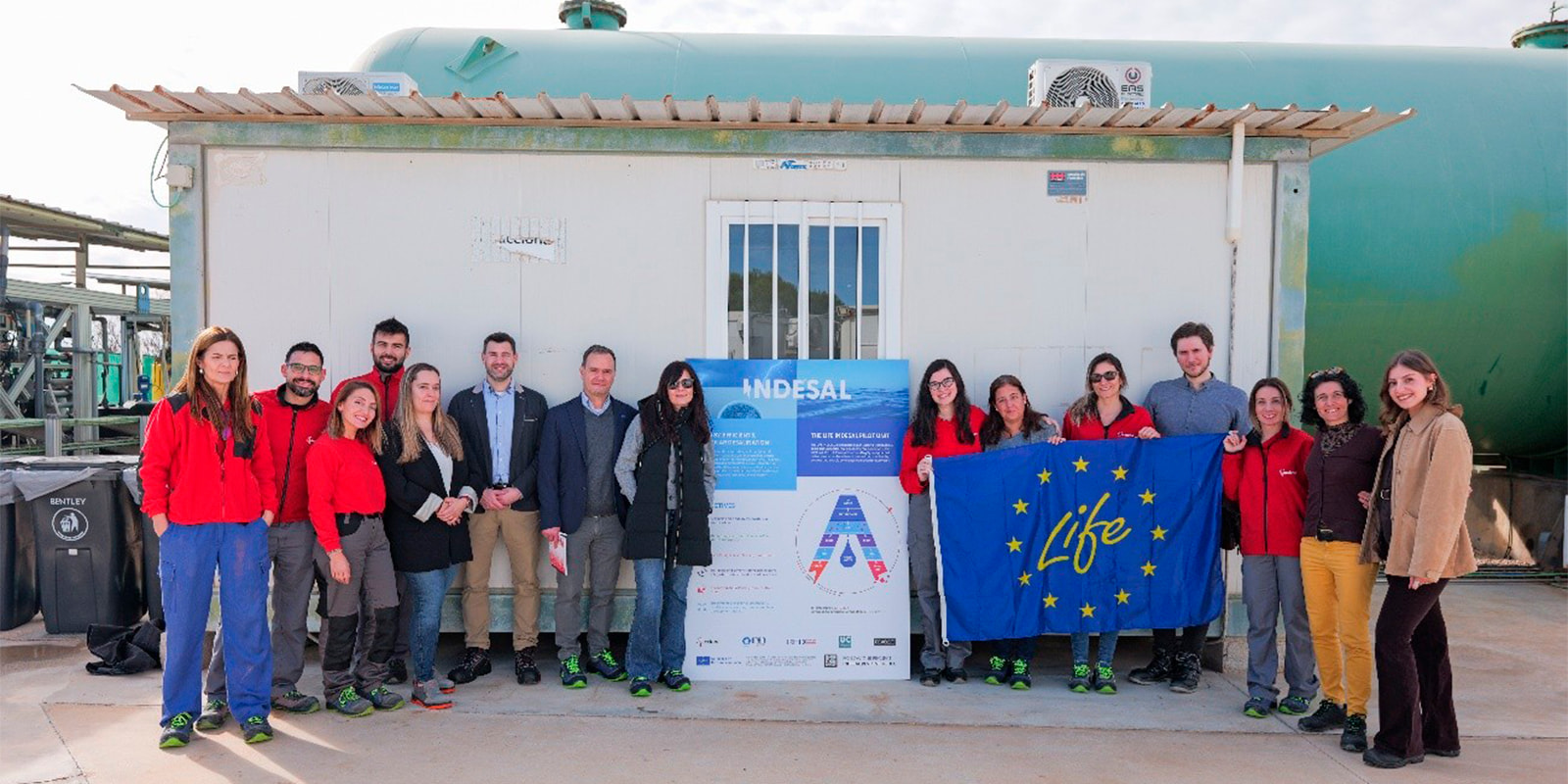
ACCIONA, as coordinator of the LIFE INDESAL European Innovation Project, has presented, together with its partners, the results of the pioneering high-efficiency desalination system that they have developed in recent years.
The developed pilot unit has successfully completed a demonstration phase lasting almost two years at the Leading Experimental Accelerator in Desalination (LEAD®) at the San Pedro del Pinatar-II desalination plant.
On the one hand, stable and efficient performance has been demonstrated through high-quality permeate production (TDS < 200 mg/L), with lower energy consumption in RO technology than traditional processes, owing to lower operating pressures and more customised cleaning strategies for membrane elements.
On the other hand, renewable energy (0.1 kWh/m3 brine) has been generated, as well as on-site production of chemicals from brine. This supplies 100% of the chemicals required for cleaning procedures, which increases the plant's operational self-sufficiency.
The solution developed in the LIFE INDESAL project can be scaled for implementation in both new seawater desalination plants and partially modified plants, as well as in other industrial applications.
The project, with a budget of €3.1 million, has the collaboration of the Department of Chemical and Biomolecular Engineering of the University of Cantabria (Spain), an institution with a long history of recovering energy and materials from residual liquid and gaseous effluents; APRIA Systems, a spin-off from the University of Cantabria with experience in advanced separation technologies for the treatment and valorisation of different types of streams; REDstack, a Dutch company focused on the development and marketing of electro-membrane stacks and processes such as reverse electrodialysis, electrodialysis and related applications, and REVOLVE, a Belgian entity with extensive experience in communication in the water sector.
POSITIVE RESULTS
The presentation event of the project, titled “Future trends in the field of desalination,” highlighted the potential of European innovation and collaboration to make progress towards more sustainable, circular, and energy-efficient desalination models that are especially designed to address the growing challenge of water scarcity.
The event was attended by researchers, organisations, and representatives from other European projects, creating a forum for knowledge exchange in desalination and efficient water management. In addition to disclosing the project's main results and achievements, synergies with other European initiatives and projects related to LIFE INDESAL were explored. During the session, the Desal Innovation Showcase provided a platform for experts to present emerging technologies shaping the industry's future and to offer innovative solutions to improve energy efficiency and process sustainability.
The collaboration of the Mancomunidad de los Canales del Taibilla (MCT) is appreciated, for facilitating the installation of the pilot unit and the provision of services. LIFE INDESAL (LIFE21-ENV-ES-101074444) is co-funded by the European Union. The views and opinions expressed here belong solely to the authors and do not necessarily reflect those of the European Union or the European Executive Agency on Climate, Infrastructure and Environment (CINEA). Neither the European Union nor the granting authority can be held liable for them.